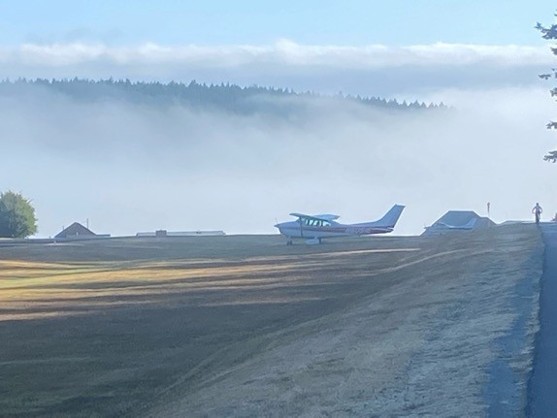
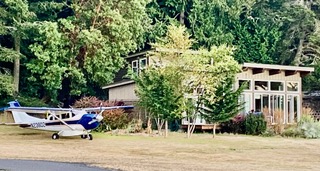
There are flamingoes and gnomes and reflecting balls, but in the San Juan Islands in Washington’s forested Puget Sound, there’s no more arresting lawn ornament than an airplane.
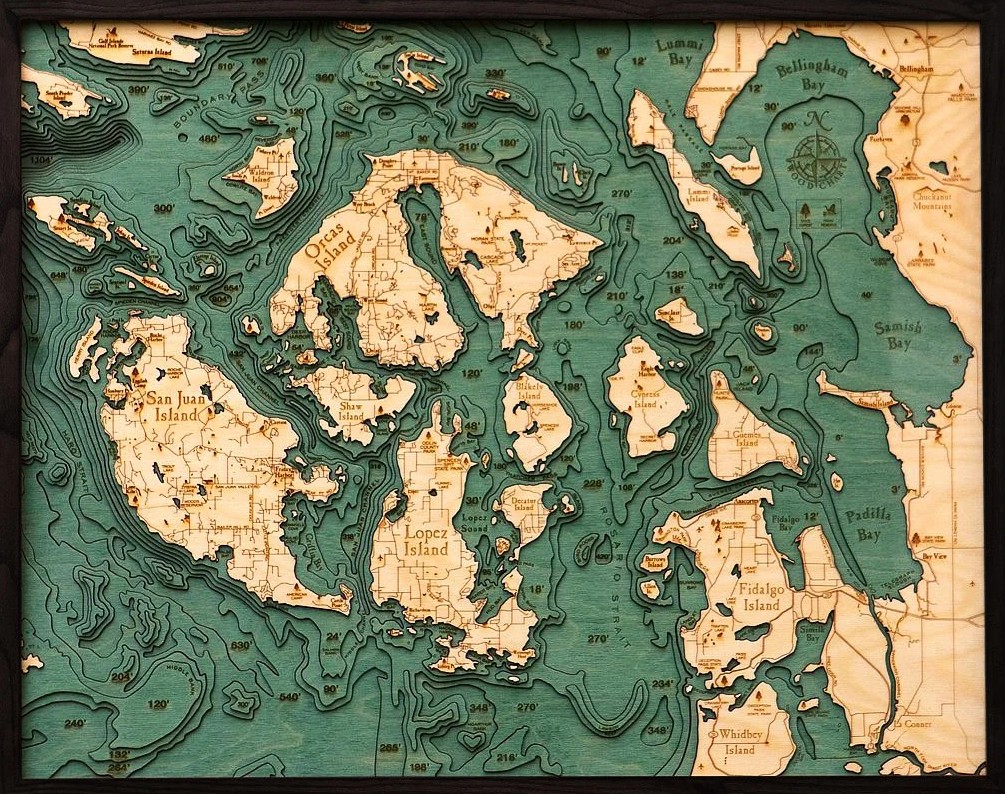
If you live on Blakely Island, a plane is the most likely option. Blakely is unique in having been developed specifically with pilots in mind. Because there are no bridges connecting the San Juan Islands, and the Washington State ferries connect only the four largest islands, one still needs a way to traverse air or water to get to the rest and to the mainland. Throughout the islands, a small plane is by far the quickest way to get around.
Airstrips abound, and you are likely to find more pilots per capita attracted to these islands than any area of the United States. Bob Breidenthal is a good example. “Lindbergh was my dad’s childhood hero,” he recalled. His father was a test pilot, flight instructor, and during World War II, the personal pilot of the commanding general in the South Pacific. Growing up in Wichita, Kansas, called the Air Capital of the World as home of companies like Cessna and Beechcraft. Breidenthal was immersed in flying lore. “As a kid, I thought I’d be a military pilot, but my eyes weren’t good enough,” (good enough for commercial, but not a military license).
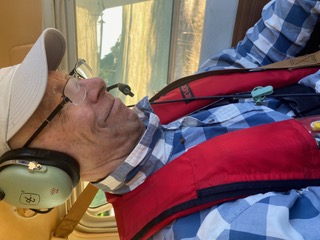
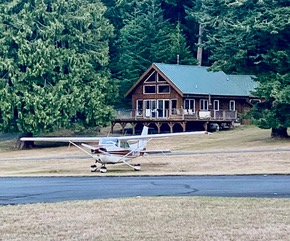
At Wichita State University, Breidenthal joined ROTC and then shifted to lessons through a flying club. He majored in aeronautical engineering and with a doctorate from Cal Tech, launched an academic career at the University of Washington. Meanwhile he learned to fly gliders. He was eventually unable to resist his uncle’s 2001 offer to sell him his “chicken hawk”, a 172 Cessna Skyhawk, inspiring him and his wife Susan to buy a lot on Blakely Island and build a cabin. The chicken hawk now perches in front. Even a PhD doesn’t teach the unique challenges of owning an island plane. He quickly learned. Issue #1: take-off and landing.
At the Arlington Municipal Airport, where Breidenthal keeps his plane on the mainland, the runway is a luxurious one mile long. Pilots landing on Blakely on the other hand face a runway only a half mile long with water at each end. “If you suffer a power failure at an awkward moment, you’re going swimming,” Breidenthal warned. “If you ditch — you’ll probably survive the ditching, but the water is so cold, you’ll perish in half an hour, so you should always fly so you can ditch close to shore…If you have a choice between water or trees, a lot of pilots recommend the trees,” he said. “The airstrip is [also] notorious for squirrely winds, a low altitude windshear at the south end…so experienced pilots almost invariably prefer to land from the north heading south and accept a tail wind.”
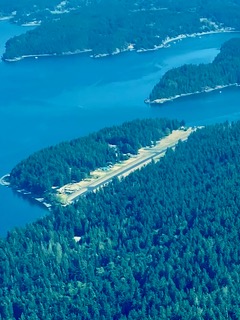
Taking off from Blakely also has its own unique protocol. Because the runway slopes up to the center from the north end, a pilot can’t see the entire runway from either end. One is supposed to taxi to the center (the highest point) to confirm the runway is clear before returning to the end to take off. There is no control tower, so radio calls and sightlines are what keep planes from collisions. Pilots making their first visit to the island normally check in with the airport manager for advice.
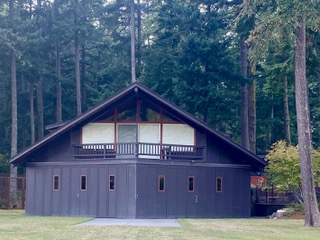
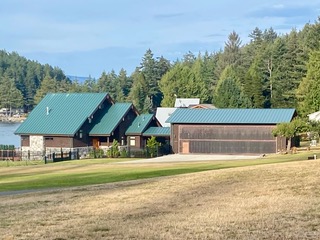
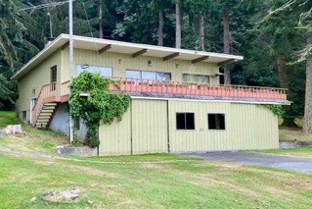
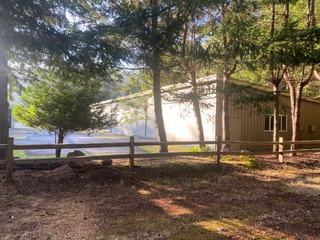
Watching planes land and take-off is a favorite pastime of residents with planes, so houses along the runway have always been popular. Several families have added their own hangars attached to or incorporated into their property. For others, there are hangar “condominiums” for purchase with a 99-year lease on the land.
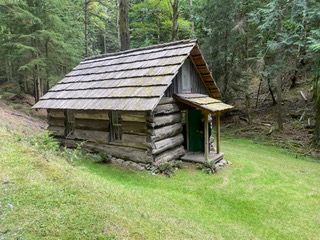
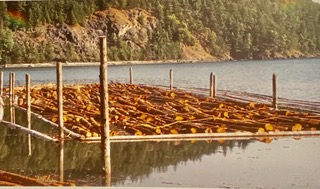
These families were hardly the first people to enjoy a Blakely Island getaway. Native Americans from the Salish tribes inhabited the area when Spanish explorers first arrived in the late 18th century. Although several middens [piles of discarded shells] have been found on Blakely, it doesn’t appear that the island was ever the site of a permanent Indian village, but likely a location for seasonal ceremonies and feasts. Blakely was named by American explorers in 1841 after naval officer Johnston Blakely, a hero of the War of 1812. From the late 19th century, early settlers harvested the island’s timber. Logs were assembled in rafts and floated to nearby sawmills well into the 21st century. A one-room schoolhouse, used until the 1940s, and several residential log cabins have been preserved and restored.
In 1954, Blakely was purchased by Floyd Johnson, who had searched for a location to develop what he would call the San Juan Aviation and Yachting Estates. He carved out a series of lots on an airstrip for people with small planes and created a marina for boaters. Advertising in places like a Portland, Oregon flying club magazine, he attracted potential second home buyers to the island with a small motel and restaurant. Johnson retired there himself. The restaurant and motel have long since been converted into private homes.
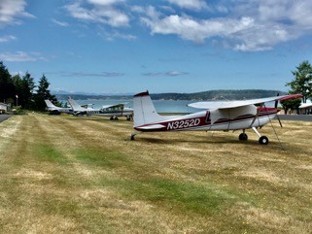
Among the first group of purchasers was the late George Warden, a retired navy pilot who continued to own planes after he left the military. His son Len’s earliest memories are flying with his father and coming to Blakely, where the runway was lined with planes. Len eventually shared the family home with his sister. After he and his wife Stephanie chose to live half-time on Blakely and in Seattle, he purchased his own plane and later bought the house across the runway.
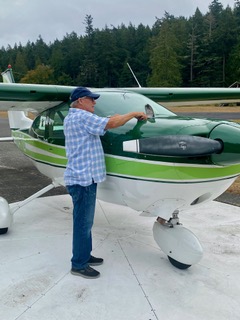
“It took 3 to 4 hours to get to Blakely by boat from Seattle. I grew up around planes, and it made sense to get my pilot’s license and buy a plane,” Warden said. The door-to-door trip by plane was closer to an hour. “It’s our primary means of transportation now; it’s sort of our station wagon.”
“Our airspace allows for some of the greatest freedoms anywhere in the world,” Warden pointed out. “Europe is highly restricted. China doesn’t even have general aviation. You can’t just get an airplane and fly somewhere in China and have the services you have in the United States. We have a complicated air system but as long as everybody understands it and plays by the same rules, it works.”
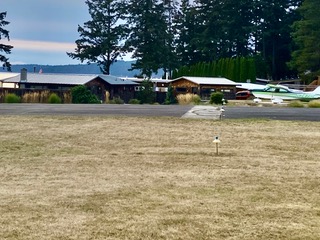
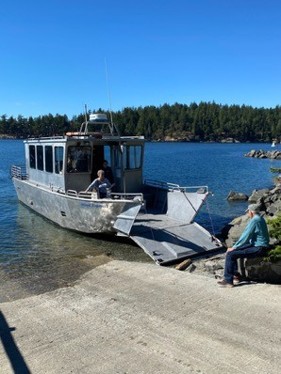
Most of Johnson’s original buyers had planes. Today, of about 100 homeowners, 23 own planes and several more book charters; most of the rest keep boats in the marina. The remaining residents rely on water taxis, the Island Express’ fleet of five boats, the island’s closest equivalent to Uber.
Keeping a plane on a small island, with or without a hangar, is not exactly like having a car. Yes, one needs a place to take off and land, but there are other issues to keep in mind. Warden fortunately has never had an accident, but issues arise that require help. “I had a flat tire,” he said, “which is a real pain in the ass here.” You can’t just pull out the spare tire. You must fly an airplane mechanic to the island and make sure he/she has the correct equipment for the particular tire and plane.
And then there are the deer.

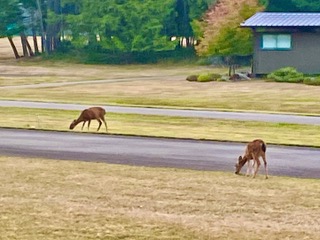
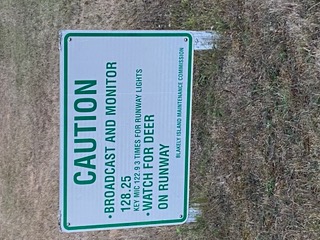
Many airstrips on small islands are not paved and even those which are, are often adjacent to grassy areas, attractive to browsing deer. These large mammals are used to humans and airplanes alike. They can do serious damage to planes not to mention passengers. Although there are no recent reports of accidents caused by deer, Blakely and other islands have deer warnings posted. Pilots sometimes do low flyovers to nudge animals off the runway, a strategy that only sometimes works.
Deer on a runway are not the only hazards for pilots flying in the San Juans. Each air strip has its own additional idiosyncrasies: “Stuart Island, Decatur Island, these are just dirt runways. Decatur is like landing in a punch bowl,” notes Warden. Trees can also be an issue. “Crane Island is probably the spookiest…you’re landing in this narrow strip between towering fir trees.”
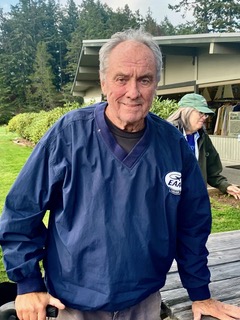
Maintaining the quality of the Blakely runway, which is owned by the homeowners’ association, is the job of the airport manager. Dan Roach currently has that role. Unlike Bob Breidenthal and Len Warden, Roach had no plane lovers in his family growing up but was just personally always interested in flying. He took lessons at the University of Oregon and flew for fun. Married to Ellen, who grew up flying with her father, a flight instructor, the Roaches began looking for a second home. Thanks to Ellen’s having seen Blakely as a child, they bought a Blakely cabin in 2003, built a second home and eventually moved in full time. As the volunteer airport manager, Roach keeps the FAA records up to date on the planes based on Blakely and makes sure the runway is maintained. He will supervise the upcoming resurfacing. He also talks pilots landing on Blakely for the first time through the possible runway downdraft and of course the deer. He keeps his own two planes in one of the island hangars, a Cessna 182 and a Piper J-3 Cub, the latter requiring only a regular driver’s license to fly, as it’s considered a “light sport” plane — low and slow.
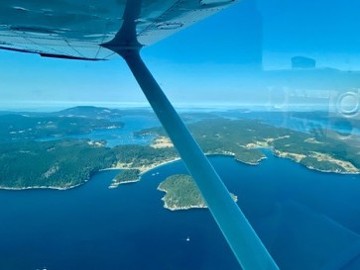
Many of the plane owners on Blakely have family military pilots in their background but the most common path to small plane ownership seems to be flying commercial airliners. John Fite has both. A member of the 9th graduating class of the Air Force Academy, he spent 21 years in the air force before switching to commercial aviation and spending 17½ years with United Airlines, flying 727s, 737s, and 747s. Like Dan Roach, it was John’s wife Nancy who brought him to Blakely with her family. The two families bought the lot and built their house together in 1978. He flew her father’s Cessna 180 off and on for several years and eventually bought it.
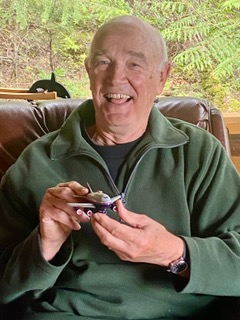
Owning a plane can be an expensive hobby and presents unusual challenges. What’s the appeal for these pilots?
John Fite: “It just gives you a lot more control…we can get up here in an hour and a half…with three kids, a dog, and groceries for a week. The 180 is like a pick-up truck. Part of the joy of coming here is you get to fly around. It was easy to have an excuse to fly.” He also created new reasons to fly; he raised money for his church by charging parishioners to fly them around Mt. St. Helens.
Bob Breidenthal, “One of the things I love about flying is this terrific freedom. [When I temporarily couldn’t fly] I missed having the convenience of a magic carpet at my beck and call…it’s freedom.”
“You don’t have to follow a road…you can point the nose of the airplane wherever you want. I love the view, the three dimensionality…it expands your mind. In a word, it’s freedom.” Len Warden: “It’s been life changing in a lot of respects for our lifestyle here, for the freedom to come and go as we choose for the most part…it’s been a great run. I know I’ll age out of flying but I don’t feel I’m quite there yet.”
Dan Roach: “It’s a real privilege to have a private airport and have an ideal place to live… We’ve both done a lot of traveling and always come back and feel this is our favorite place.”
For non-pilots, flying in a small plane can be a glorious experience — or it’s not. I was in high school when I first flew with my uncle in his Cessna from Cleveland to Salem, Oregon and loved steering over Chicago. We landed in a cornfield to visit a family farm. On a clear day, the views are stunning. For many, however, particularly those flying in a small plane for the first time, it can be frightening. My mother-in-law, for example, on her first such trip, exited the plane and immediately kissed the ground. Another relative, a passenger in a four-seater en route to Manzanillo on Mexico’s west coast, had a different reaction. She reported that when things got rough flying over the mountains, she urged the pilot to “Ride ‘em Cowboy!” That’s the attitude for owning one’s own plane!