
Stairs allow us to ascend and descend practically and metaphorically, and sometimes stairs could show us history. In western Honduras, an ancient stairway is a prominent site of Maya civilization. In 1576, Spanish explorer Diego García de Palacio, who was in Central America, discovered the ruins of the city of Copán and wrote King Philip II of Spain about Maya architecture. More than three hundred years later, in 1885, British archeologist Alfred Percival Maudslay, who went to the ruins, discovered a Hieroglyphic Stairway that was then excavated (1892–1900) by a team who arrived from Harvard’s Peabody Museum. The excavated stairway needed repair since more than half of the steps were damaged due to weathering, and the Carnegie Institution of Washington was able to reconstruct a major part. Hence this Hieroglyphic Stairway from 755 CE had become the most descriptive Maya text telling the history of the Copán rulers.
Escaping history, mid-century architect Ludwig Mies van der Rohe (German American, 1886–1969,) known as Mies, immigrated from Germany to the United States around 1938. Mies was asked to head the department of architecture at the Armour Institute in Chicago (later renamed the Illinois Institute of Technology,) and created an outstanding program that impacted generations of future architects. In the 1940s Mies had become a leading modernist, and supported the idea that “less is more”. His buildings and structures were mainly made of steel and glass, displaying clean and elegant open spaces.
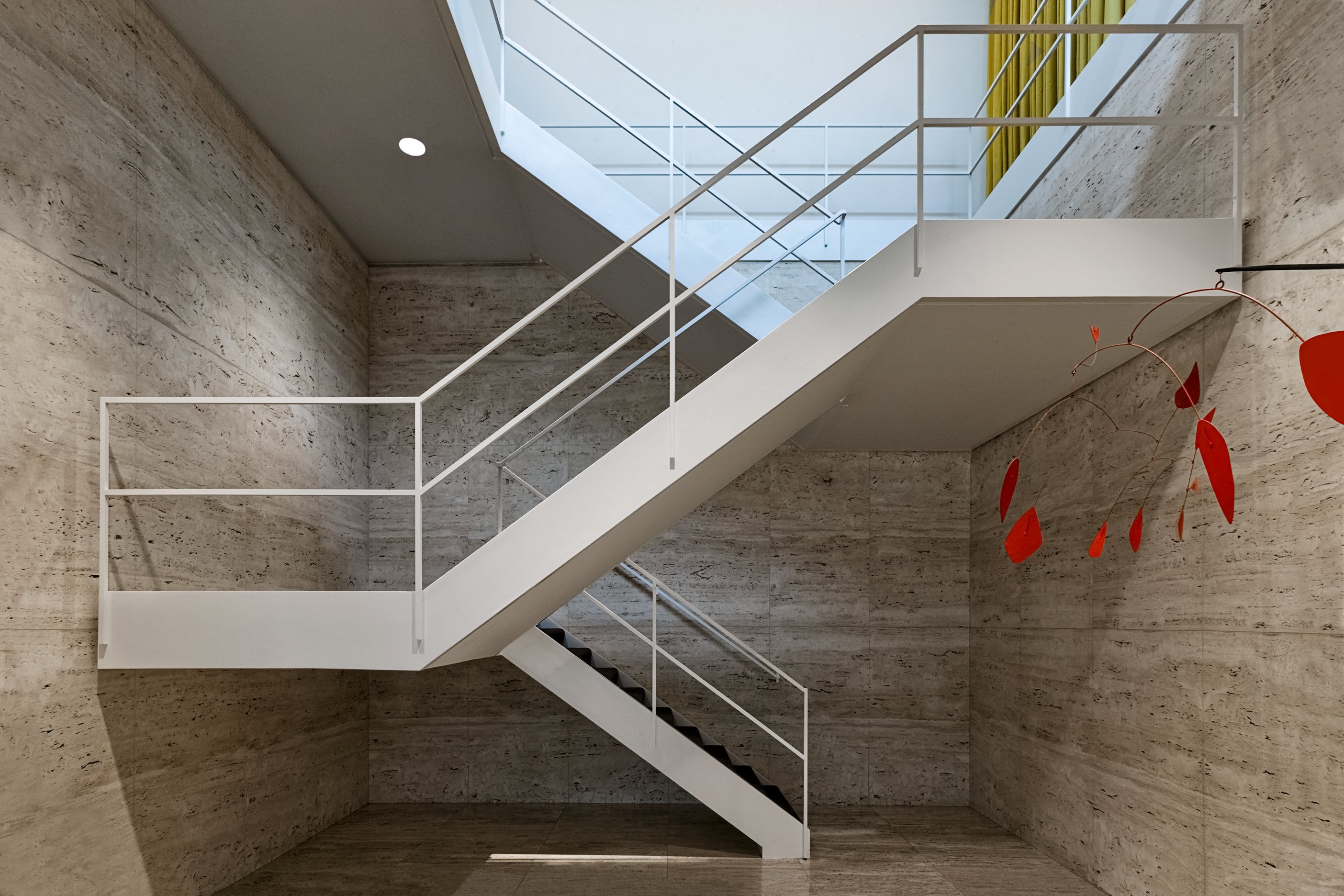
In Chicago, Mies was a member of The Arts Club of Chicago that exhibited contemporary art, and promoted established and emerging artists from around the world. In 1951 Mies completed a “floating staircase” for The Arts Club of Chicago, at 109 East Ontario street. The remarkable structure was composed of steel and travertine marble. In 1998, when The Arts Club of Chicago had to move to a new location, the staircase was salvaged and reinstalled by architect John Vinci. The staircase was both functional and a beautiful piece of history in the two-story masonry and glass building at 201 East Ontario Street in Chicago.
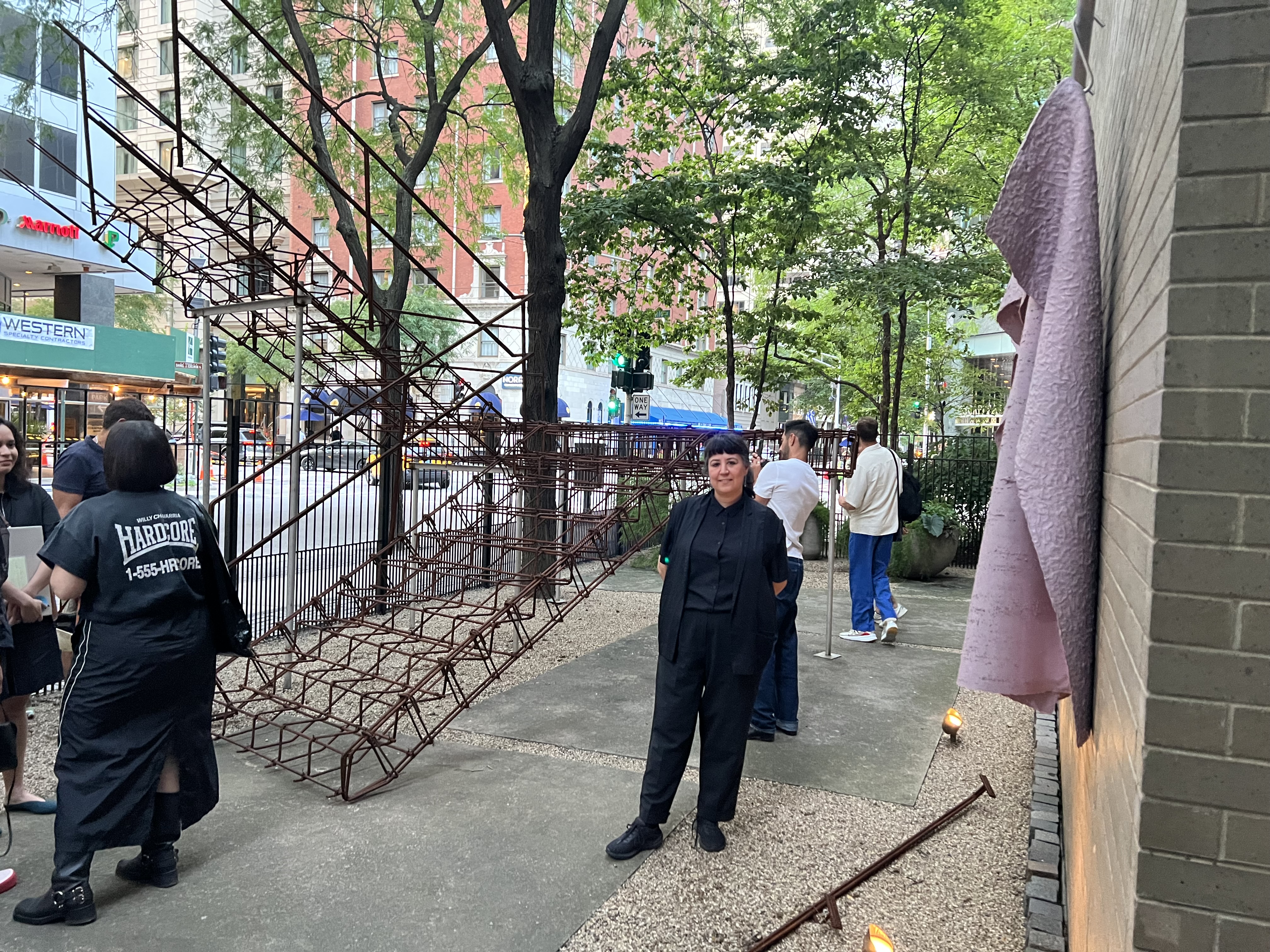
Currently, the exhibition at The Arts Club of Chicago is a garden installation by Leticia Pardo entitled “Leticia Pardo: Carcasa (109 E. Ontario St.), 2026”. Pardo, who is an artist and architect based in Chicago, originally from Mexico City, focuses on issues of migration, borders, citizenship, communities, and her work reflects the resulting environments. Employing various media, Pardo responds to specific sites engaging personal and political narratives.
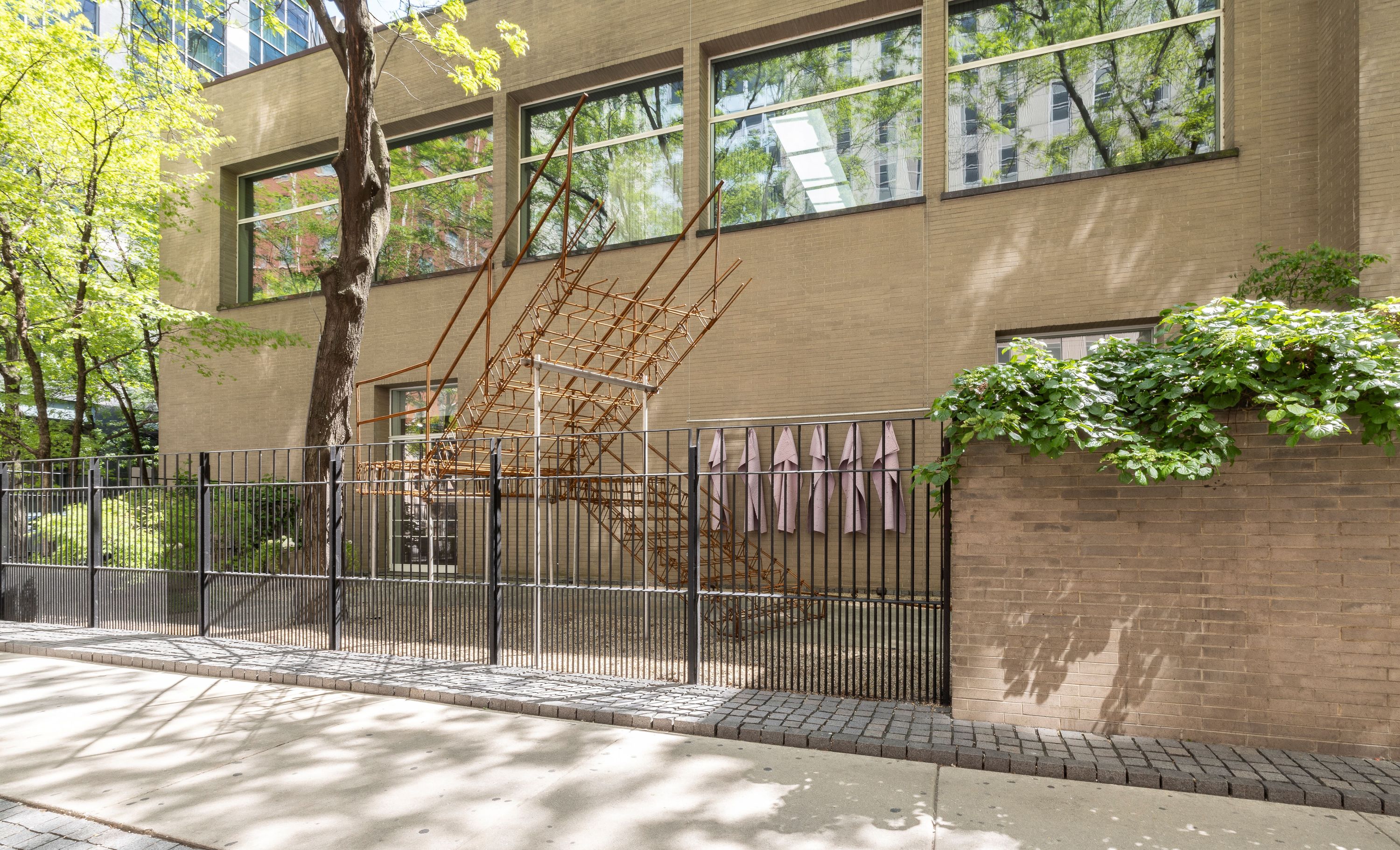
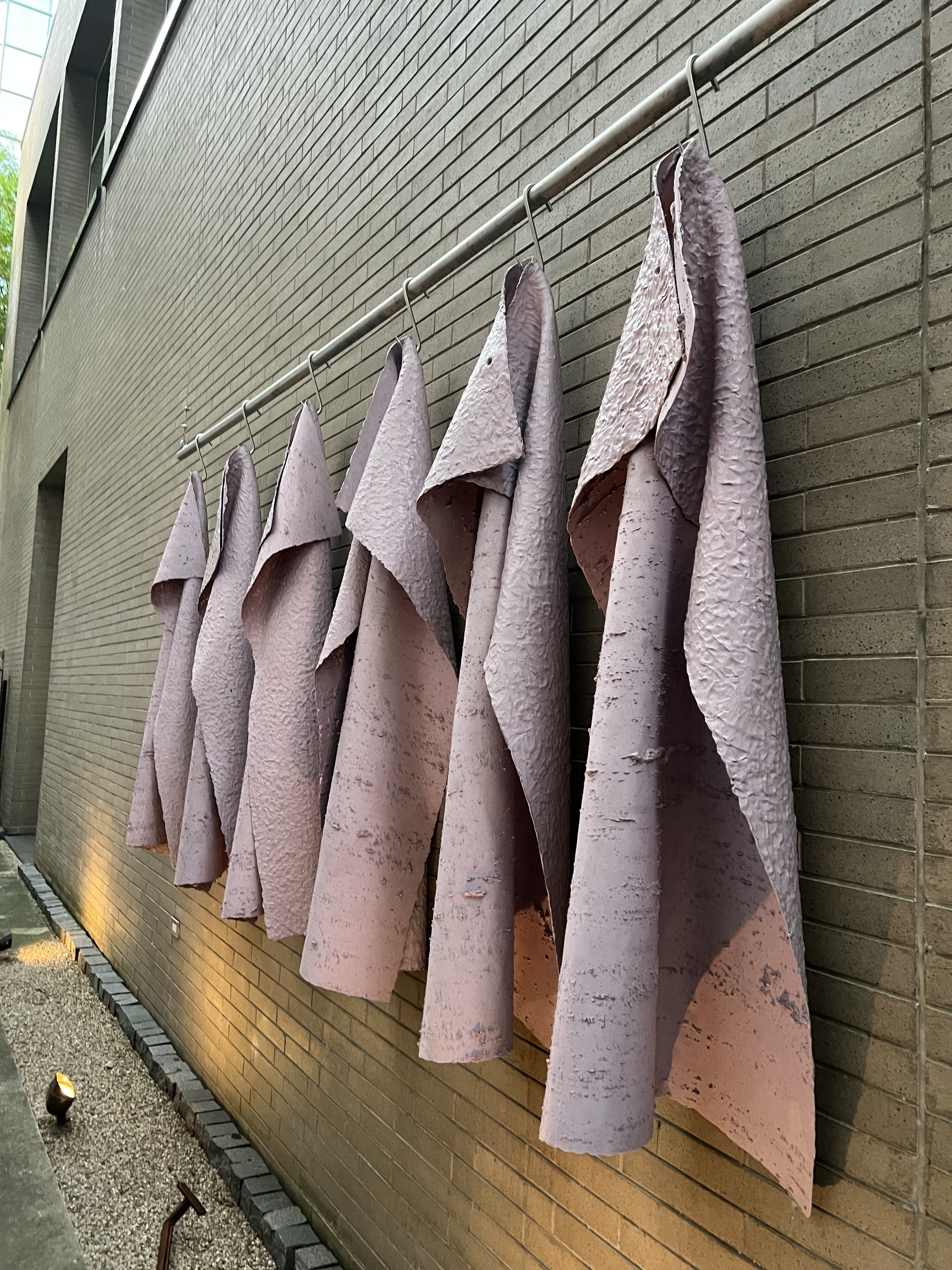
At The Arts Club of Chicago, Pardo is revealing the often invisible aspects of construction. In the garden, outside, Pardo is showing an interpretation of the staircase and walls that exist inside the building. Through a rebar reproduction of the interior staircase, she moves the construction to the surface, and focuses on the labor done by immigrant workers that remain unrecognized. Moreover, silicone casts that Pardo took from the travertine slabs surrounding the staircase, become reverse impressions of the walls. “Together, the rebar structure and silicone casts establish a dialogue between structure and body, visibility and concealment, and value and labor. Reducing architecture to bone and skin, Carcasa (109 E. Ontario St.) approaches modernism as a system whose authority and visibility were produced through selective recognition. In doing so, it positions architecture as a cultural record of collective making shaped by social relations.” (Source: artsclubchicago.org)
.JPEG)
At The Arts Club of Chicago the garden installation could be viewed from the sidewalks for the venue is closed until September 10. When the venue opens again, viewers could enter the garden where the installation would be on view until September 19, 2026. Please note that Pardo’s garden installation involved production assistance by Dishan Rahman, and metal fabrication by Alejandro Castellanos, Ernesto Garcia, Jair Martínez, José Martinez, Ricardo Martínez, Danilo Medina, Ernesto Medina, Gonzalo Medina, Nelson Ramírez, Francisco Rivadeneyra, Heriberto Valdez, Daniel Valencia, Randi Vigueras, D5 Design and Metal Fabrication.

