
Chicago: A Phoenix from the Ashes
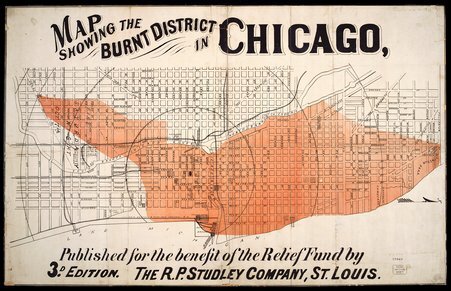
The Great Chicago Fire began on October 8th, 1871, and burned for two days until it had destroyed some 17,000 buildings and left approximately one hundred thousand people, one-third of the city's population, homeless. Its reach and destruction were exacerbated by the wooden construction of the city's buildings and sidewalks, a very dry summer, and a misdirected, worn-down fire fighting team. Its destruction was limited to the North Side, leaving the stockyards and lumber yards mostly intact. While the fire was devastating, they were also an opportunity for the city to re-invent itself, including clearing the way for greater buildings of steel and concrete that would come to define its downtown and skyline, including the world's first skyscraper: the Home Insurance Building, opened in 1885.
1880 was a very important year for the city. Firstly, it represented Chicago claiming the second-place population crown from St. Louis; the city was now home to over five hundred thousand residents. 1880 also was the year when meatpacking products made up 1/3 of the value of all of Chicago's manufactured goods. This was due, in part, to the eradication of buffalo on the frontier, and the closure of the land for cattle grazing, driving up the amount of stock entering the city. It was also driven by a basic economic incentive: farmers could either sell their grain, a bulky, low-value product, or feed it to animals and concentrate it into a denser product more easy to transport. This dominance was not without cost, however; "Bubbly Creek," the branch of the Chicago River used by the Union Stock Yard to dump their offal, was so polluted that observers reported seeing small animals scampering across its surface. Finally, in 1880 the city opened their first cable car line, and soon street tracks were snaking their way through the city. By 1893, the streetcars began electrifying their lines, and expanded their reach throughout the city.
With its population ballooning, and a booming industry, it was only a matter of time before Chicago would begin to see conflict between business and labor. The Great Railroad Strike of 1877, set off by wage cuts from B&O Railroad in West Virginia, spread all the way to Chicago and across the nation, with more than one hundred thousand workers participating, practically paralyzing the nation. George Pullman, of the Pullman Palace Car Company, responded to this by creating a company town in his name on the South Side; Pullman, Illinois. The Union Stock Yards were a hotbed of union organizing, and its workers were key in organizing the eight-hour-movements of 1878 and 1886, where they managed to win the desired eight-hour workday. The Haymarket affair, where an anarchist bombing set off retaliatory police violence, would see the workers go back to working more hours, in exchange for greater wages. In the Pullman company town, during the economic downturn of 1893, a total strike of its workers began after the company decreased wages but maintained the rates for rent and essentials in the company stores. So complete was the strike that the federal government sent in the national guard to force the laborers back to work, and even invoked the Sherman anti-trust act against them to protect Pullman. These events dealt severe blows to the labor movement in Chicago and across the U.S., and it would take decades of organizing to rebuild their strength and ability.
The Turn of the Century
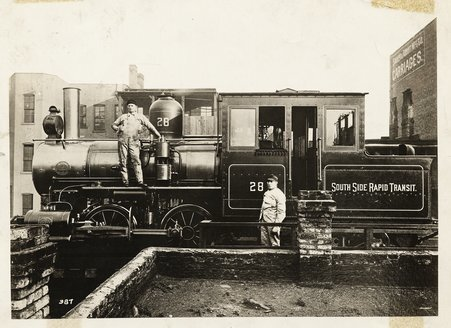
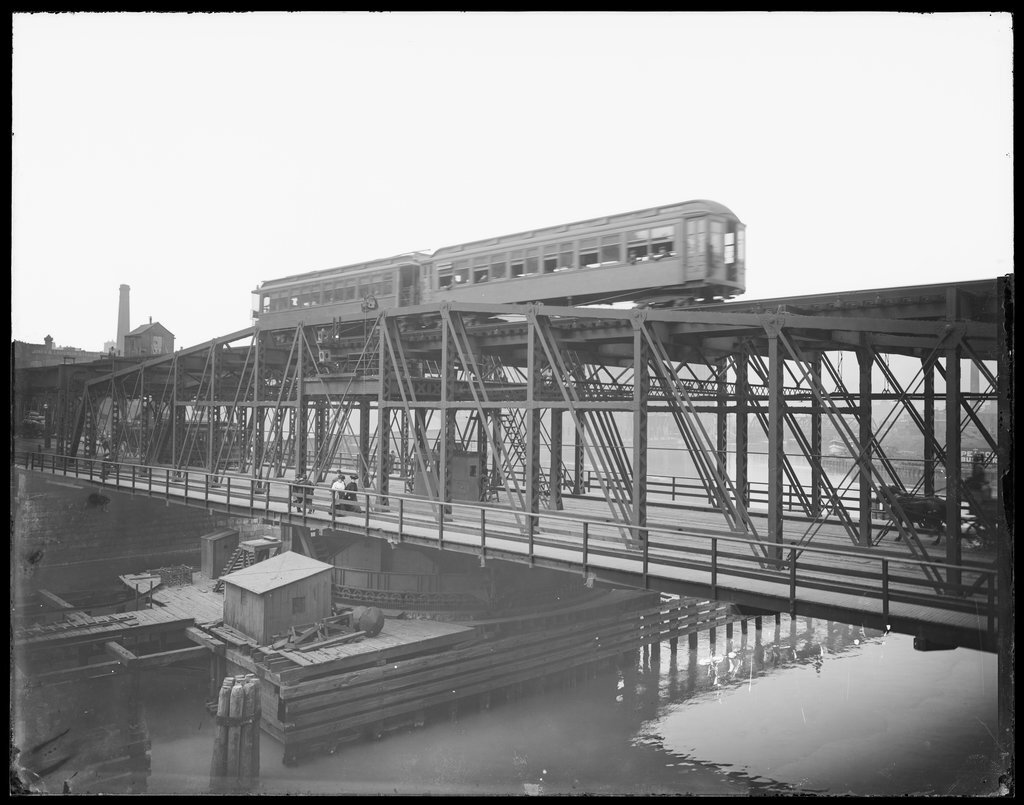
By 1900, Chicago's future was looking brighter than ever before. It had truly become the "second city" of the nation, surpassed only by New York. 1892 saw its first ever L train run, from Congress to 39th street in a mere ten minutes. It acted as a starting pistol for other light rail companies: by 1899, four other businesses had incorporated, and these five entities would build stations that would become the Red, Blue, Green, Brown, and Pink lines as we know them today. When the city hosted the 1893 World's Fair, more than 400 trains ran daily to service it, bringing millions of visitors, national and international, it was helped by its streetcar line, which was the largest in the world by that year. By 1900, the city's population had grown to nearly 1.7 million. This also coincided with the reversal of the Chicago river, in order to send the city's waste away from Lake Michigan, which also signaled the death knell for the Illinois and Michigan Canal as a method of shipping, solidifying the railroads' dominance in the city. As the west coast and interior was settled and developed, and as the east coast only continued to grow, Chicago reaped the benefits of being the wheel in a wheel-and-spoke system, as well as developing its already significant manufacturing output. Out of 225,000 miles of rail in the U.S. by 1900, 100,000 of them connected directly to the city, with 1,300 trains entering or leaving each day.
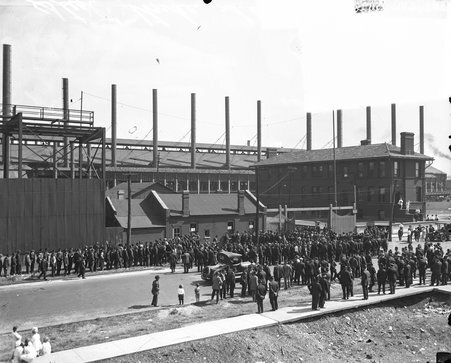
The industry of Chicago was no longer just that of transit of bulk goods and artisan manufacture like that of the 1850s. Its railroads meant it was ideal for heavy industry and other input-intensive manufacturing, where the finished product's weight was a fraction of its input goods. Steel was a favorite; Gary, Indiana was essentially a steel-based company town that helped feed Chicago's factories. By 1920, half of the people employed in the city worked in some manner of manufacturing. Meatpacking remained a major driver of the economic engine; the city's packing plants produced 60–90% of the east coast's meat products, and 90% of international beef exports. Upton Sinclair's The Jungle brought much public attention to the (allegedly exaggerated) conditions of the meat in these plants. But by this time, Chicago was also becoming a financial and shopping center. Sears, Roebuck, and Co, founded in Minneapolis in 1890, relocated to Chicago in 1894, and was garnering more than a million dollars of revenue shortly thereafter, selling people everything (except fresh fruit, vegetables, and live animals) by mail-order catalog.
Like most cities in the U.S., Chicago's population was built more by immigrants than by citizen births during this time. Its first migration wave was primarily German and Irish, through the 1850's and 60's. Naturally, they reached the city via rail after arriving from their homelands in New York and other Atlantic ports. By 1860, approximately 50 percent of the city's hundred-thousand-strong population was foreign-born. As time progressed, the railways got better, and the city got more attractive, so the flow of international hopefuls only sped up. The makeup of the second wave, from 1880–1920, was only more diverse, this time from southern and eastern Europe. Poles, Italians, Czechs, and others of all stripes started their lives and found communities in the city, some of them numbering so many that Chicago became, at one time or another, the second largest Czech, Lithuanian, or third-largest Irish, Swedish, Polish, and Jewish city in the world. Nearly one in three of its 2.7 million residents were foreign-born in 1920, and while the children of these immigrants would assimilate quickly, the city's ethnic neighborhoods stand today as reminders of the culture and pride of their people.
The Peak of the Mountain
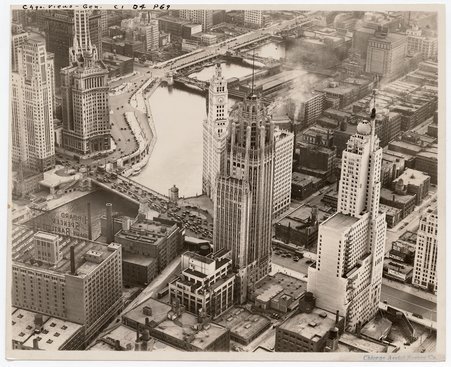
1920 was, in many respects, the "height" of Chicago's powers and prestige in many respects. And while the city has a few decades of enjoying this peak, it has stopped climbing and started a subtle decline. The Union Stock Yard, for instance, recorded its largest stock load in 1924, with 18.6 million head of cattle, sheep, hogs, and horses, not including those already sold to be processed at the plant. Refrigerated rail cars meant that ranchers could sell their animals to local plants that processed on-site and ship the meat, instead of transporting the whole animal. Rail construction had slowed to a trickle by 1920, as the needs of the market were already met, and trucks and automobiles began edging out trains for transporting people and goods. The number of people carried by rapid transit peaked in 1926, and automobiles were registered at a pace of more than thirty thousand a year through the 20s. The Chicago Rapid Transit Company (CRT), formed in 1924 by merging the five owners of the "L" progenitors, expanded its services to serve more than six hundred thousand passengers daily to 227 stations on over five thousand scheduled trains. However, despite this, it spent most of its existence in bankruptcy or receivership, managed by fiduciaries appointed by the U.S. District Court.
Starting in the nineteen-tens, Chicago was again having its population swollen by migration, but this time it was an internal one. The First Great Migration of black citizens from the south, brought on by hope for better prospects up north, concentrated most of its new residents in the South Side as trains ferried them to their new homes. But Chicago was not the land of equality the former sharecroppers had hoped for; the 1919 race riots, caused by the murder of a black child, left dozens dead and hundreds wounded, and outlined the city's racial tensions for generations to come. Prohibition in 1920 would greatly expand Chicago's seedy underbelly, but the city hardly became a site of open gang warfare as many may believe. What really rocked the city was the Great Depression.
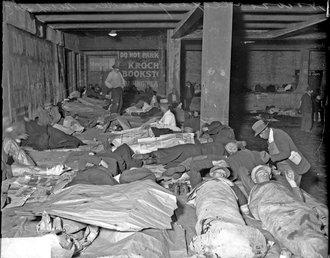
The Great Depression rocked Chicago especially hard in comparison to cities in the rest of the nation. This was due, in part, to the city's manufacturing base in heavy industry and durable goods; people and businesses stop buying durable goods first during times of economic strife. While most people were relatively insulated from the initial stock market crash in 1929, affecting mostly finance-men, by 1931, everyone was feeling the pain. At its peak in 1932, unemployment reached forty percent of the population, felt especially by the city's black population, whose employment was primarily in "unskilled" fields. Industry employment was cut in half, thousands of houses were foreclosed upon, and construction within the city completely collapsed. Between 1934–1937, approximately one-third of the city's population received relief money. Chicago gradually pieced itself back together, thanks in part to programs like the New Deal, but it would take until World War II before the city could truly recover.
Conclusion
Chicago, after already reaching the top among cities in the midwest, by 1900 had become a jewel in the U.S., second only to New York: teeming with people, a booming industrial sector, a growing financial sector, all built on the bedrock of its wide-reaching and deep-rooted railroad network. It has been hit hard by the depression, and while it will recover thanks to the Second World War, the introduction of the automobile and gradual dismantling of national industry means that the city is fated to suffer a moderate decline in prestige as it enters the modern age. Look out for next week's article, which will pick up in 1939, and cover the rest of history for the city until now.