
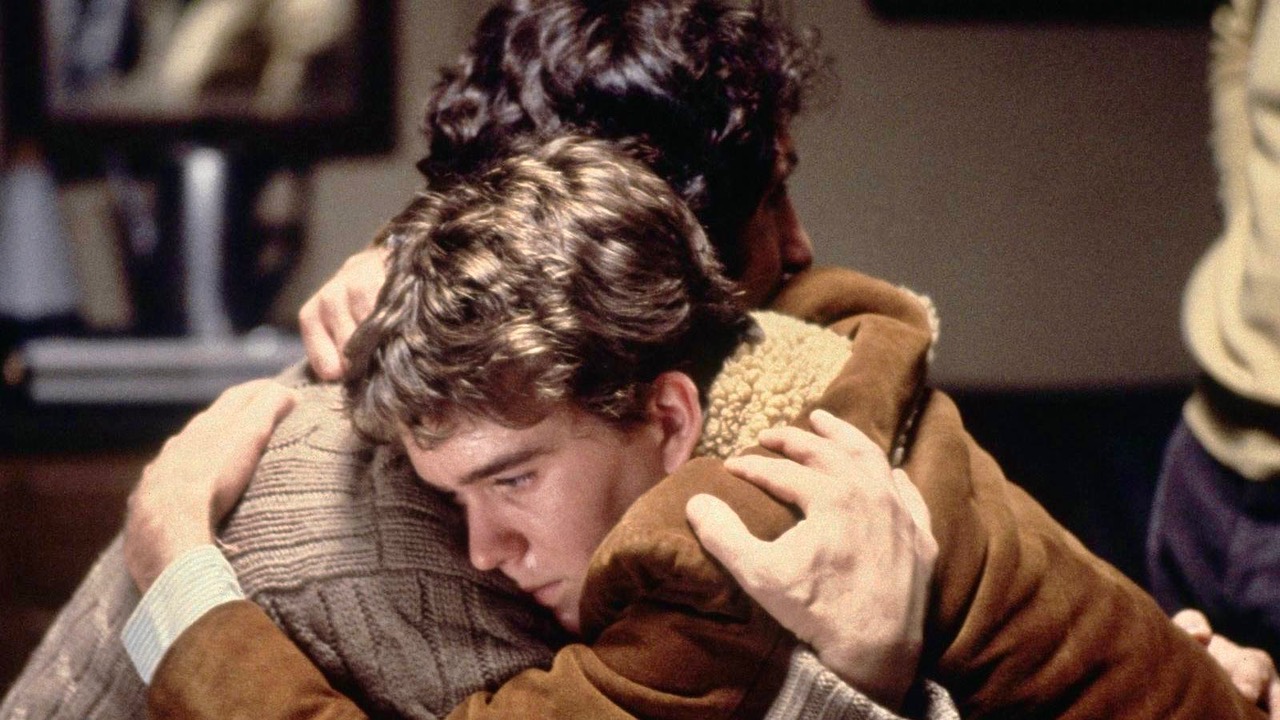
The movie based on the 1976 novel by Judith Guest refines the book’s stillness and spaciousness. Directing his first film, which, incidentally, won the Academy Award for 1980’s Best Picture at the Oscars, the late Robert Redford conveys purity, turmoil and beauty with silence, music and an intelligent screenplay. Eliciting perfect acting in every scene, he brilliantly dramatizes the plot-theme: recover and restore a boy’s stricken soul with love.
Most audiences minimize the movie, in my judgment, as do most critics. The Paramount Pictures film, written for the screen by Alvin Sargent with music adapted by Marvin Hamlisch and photography by John Bailey and with sterling performances by Mary Tyler Moore, Donald Sutherland, Judd Hirsch, Elizabeth McGovern, Fredric Lehne and, especially, Timothy Hutton—gets overlooked by scholars and audiences. As is often true when a simple, elegant movie, such as Green Book or The Artist, wins Best Picture at what’s become an annual showcase for the bizarre, Ordinary People’s Best Picture Oscar backfired, prompting an immediate downgrade by critics for winning Best Picture.
My review calls for just deserts in its redemption. This is not to argue that the film has no flaws. I notice a consistency error in the party scene every time I watch—I’ve seen the movie multiple times for a variety of reasons, including having lived where Ordinary People is set—and delivery of a single line during a transitional scene always induces a cringe. Nevertheless, the drama excels in every sense and scene. It’s made with warmth, color and vitality. This is the perfect movie.
Credits open with eerie silence against blue sky as the camera descends to a calm, vast, blue lake, wafting to shore and man-made extrusions and up to trees dancing in the breeze. A blackbird flutters. A sequence of postcard pictures—falling leaves, empty roads and gazebo, a winding path—shows until a church-like building fills the frame. The whole movie’s monastic and meditative, like a quiet, powerful dream lingering in the moment. The first sign of humanity appears within a high school as children unite to sing a gentle plea: “Hear the silence of our souls.”
This is Chicago’s north suburban shore. It’s portrayed through the story of a slender boy named Conrad (Hutton) looking sleep-deprived in choppy hair before belting the hymn’s Hallelujah end with a loud “Yaaaww!!” He’s too loud for choir propriety and you instantly know it. This is confirmed in the next scene as the boy awakens from a nightmare gasping for breath. Then, you meet his parents—Beth and Calvin Jarrett, played by Moore and Sutherland—as they watch a play with the line that “I’ve never been out of love with you,” foretelling the film’s theme of moral evasion.
Everything’s in place as the couple returns home. Beth Jarrett ascends stairs to her bedroom still wearing her coat. Her husband notices a strip of light under a door—where you know resides the teenager in distress—and the father pauses, watching his wife retire. He chooses to knock on his son’s door. A conversation ensues. Suddenly, three distinct place settings appear from a bird’s eye breakfast table view, forecasting the three together at home the next morning. So begins their tale.
Before Beth refers in third person to her son, “there he is,” the audience knows that Mother Jarrett barely regards Conrad as her son. Every utterance, expression and body movement emits her discouragement or disengagement, masked by an attempt to meddle in his affairs. From disposing of a meal he’s not up to eating to her push for his social climb, Beth seeks to domineer every action in the Jarrett home. Tension’s broken by the honk of a car horn in front of the house for Conrad’s ride with his friend Joe Lazenby and teammates to school. As the Chicago and North Western train mightily takes the track, he’s triggered by the thundering train—seized by an image of a graveyard.
The sound of a crossing gate alarm and the roar of the train, to anyone who knows the North Shore, bears deadly significance. Cue public school, another haughty and disengaged, pressured place. From a pay telephone—with the phone as a symbolic lifeline—Conrad strives for ease and control. Each mindful action’s propelled by his exercising free will. This lonely one’s in search of progress.
“Push off, Jarrett, push off!!” Yells his athletic coach during swimming practice. Soon it’s dinner time and the setting’s again for three. Like the movie poster—evoking the original book jacket design—the number three pervades the picture. The trio’s disproportionately dominated by one.
“Is that shirt ripped?” Beth asks Conrad, attempting to forestall any display of emotion or discussion of serious issues. Her stifling is masked by the presumption that she aims to care—Beth’s a mother who tries to fix by fixating, all while in strident avoidance of grief over the loss of a child who was fourth in the family.
Here lies the inlaid brilliance of Ordinary People. With a director who once, like the movie’s departed, was an awarded star athlete and blond, objectified god, the movie grants grace to the ravages of unprocessed grief. Another nightmare—a visit to a psychiatrist—practicing first impressions on the elevator—going to the wrong door (with the door, like the telephone, as a symbol of access)—and being jarred from your comfort zone to learn to cope with uncertainty. Music abruptly blares, only this authority figure, the psychiatrist—Judd Hirsch as a Jew in Highland Park—unlike Beth, accepts not being in control (he’s also a talk therapist, not merely a signatory source for drugs like today’s psychiatrist). Conflict’s woven by the contrast, which challenges what Conrad knows. So begins his second becoming.
This is hard labor and, as Conrad, who doesn’t bother to remove his backpack during that first therapy session, Timothy Hutton marvelously portrays someone who attempted to end his life. Cloth napkins in shiny silver rings appear as Beth, in patterns of beige and brown slacks and sweaters, pleasantly performs a Halloween ritual for the sake of social status—never for the sake of herself or her family. Before Christmas, she lobbies Calvin for escape from parenthood, pointedly seeking without awareness of the tragic parallel to jettison her son, again, if needed to immerse the marriage in “something out of Dickens.”
On a quiet afternoon, the conflict tightens amid the sound of gravel as Conrad comes home from school. In autumn shades of brown and gold in suede, after pausing at a door to the dead child’s chamber filled with pictures, ribbons and merchandise for ice skating, the Cubs, the Fire and other sports stuff, as Beth’s caught unguarded being detached from reality, she snaps: “Don’t do that!”
“Don’t be negative,” she later tells her husband, uttering the negative. By then, Conrad’s gone rogue, meeting a friend and former mental hospital patient (Dinah Manoff in an outstanding scene) at Wilmette’s Original House of Pancakes, dating a choir girl (Elizabeth McGovern) and making private choices. “Will ya cheer up?!” comes a pressure point to obey the commandment that Thou Shalt Not be down, particularly if you’re male, from someone besides his mom with a tenuous connection to reality. Add the constant focus on Conrad’s hair and, again, the message that appearances must be kept up at all times comes across.
Ordinary People comes in clean, svelte design, accessories, wardrobe, staging and decoration—so that the family rips, tears and tucks are wrapped in upper middle class wealth and what people call privilege. When Conrad offers to help set the table—“Mom…?” he dares to venture, on the brink of vulnerability—a phone rings, allowing Beth to dodge motherhood again. “No, I’m not doing anything,” she answers, knowing her son’s just working up the courage to begin to engage.
Critics’ tendency to blame Ordinary People for being pretty, pat and clear misses this point. People think, talk and communicate—in movement and expression as well as tone, pitch and manner—in Beth’s curtness and social wrapping every day in ordinary lives. They push away, brutalizing tender souls with disapproving looks and words and the gray void of chronic evasion.
Mr. Redford depicts this without overplaying Beth Jarrett’s villainy. The threat of Conrad’s literal or psychological death by a thousand cuts looms every time she criticizes her son for leaning against a credenza, seeking help or a passing grade. The same goes for challenging her husband—“what’s wrong with you?”—when Calvin dares to admit grieving their son. Anyone who’s experienced dysfunction in the wake of loss will recognize this family portrait. That this is depicted as part of everyday life explains why Ordinary People looks and feels rich in detail. This is North Shore subculture. This—cosmetics; what today gets called optics, “optimization,” influence, metrics and analytics—is Beth’s reason for being.
A sunset in Dr. Berger’s office yields reference to John-Boy—evoking the healthier family, ethos and subculture—shifting the plot into higher gear as Calvin flashes back to conflict resolution and Conrad’s suicide attempt as Conrad discovers new knowledge in front of a flickering light. Action unfolds in fatigue, fracture and an act of revolt against Beth’s dire attempt to drill altruism into the family core.
The cast excels. Mary Tyler Moore crafts a delicate, layered performance as a parasitic North Shore socialite. Every inch of her world-famous face and the way she carries her dancer’s figure captures the essence of a woman who perfectly fits into place while in breach of reality, sacrificing her self-interest. As Calvin, Donald Sutherland pulls the plot together, displaying an emasculated man valiantly and softly trying to regain his love for life, wife and surviving son without sacrificing himself. Elizabeth McGovern as Jeannine Pratt in a crucial, supporting role, crafts a range of emotions as the preppy girl wise beyond her years. As strong and sensitive friend Lazenby, Fredric Lehne delivers a wrenching, commanding performance. M. Emmet Walsh as the coach taps the sadism which dominates the worst jocks. As Calvin’s colleague, James B. Sikking provides a springboard to Calvin’s growth and development. As Beth’s mother, Meg Mundy puts in the voice of irrationalism, concealing—and seething with—contempt for new ideas behind the veneer of concern. Adam Baldwin as a bully portrays envy to a tee with the hint of latent homosexuality. Timothy Hutton breaks Hollywood’s mold of the imperiled teenager. His is one of the screen’s best youth portraits with broad range in a perfect performance.
Interior and exterior scenes at Water Tower Place, McDonald’s, a swim meet, Evanston and the Chicago River bank capture Chicago and the North Shore as they advance an elegiac plot progression; everything’s on purpose yet natural, cinematic and heroic. You can’t stop watching. To pin the movie’s theme—with Ordinary People as an unsung closing hymn to the inner child within—you feel you must hang on and not let go. The climactic embrace between the “Jewish doctor” Beth’s mother archly asks about and Conrad packs emotional power. It’s framed in an iconic shot between patient and doctor—forming a mountain made by men—dramatizing the radical ideal that, while perfectionism’s poison, perfection is possible.
“I am,” the transformed doctor avows with new confidence, before breakfast’s restored as the child’s sustenance—spared from Beth’s earlier rebuke for daring to grieve, feel down and try to grow up. Ordinary People’s single-mindedly a movie about coming to terms with reality. Its message that obsessive compulsion—have an honest look at today’s culture—constitutes weakness, not strength, which can be remedied by being vulnerable, leaves you feeling lighter with a sense of hope.
Make life easier with love and its explicit expression, Alvin Sargent’s screenplay urges the audience. By the time the camera pulls back, rising up to where the story began, Ordinary People ends with a door ajar, elevating this intimate movie with a sense of possibility amid patches of snow depicting the evolution of a family man.