
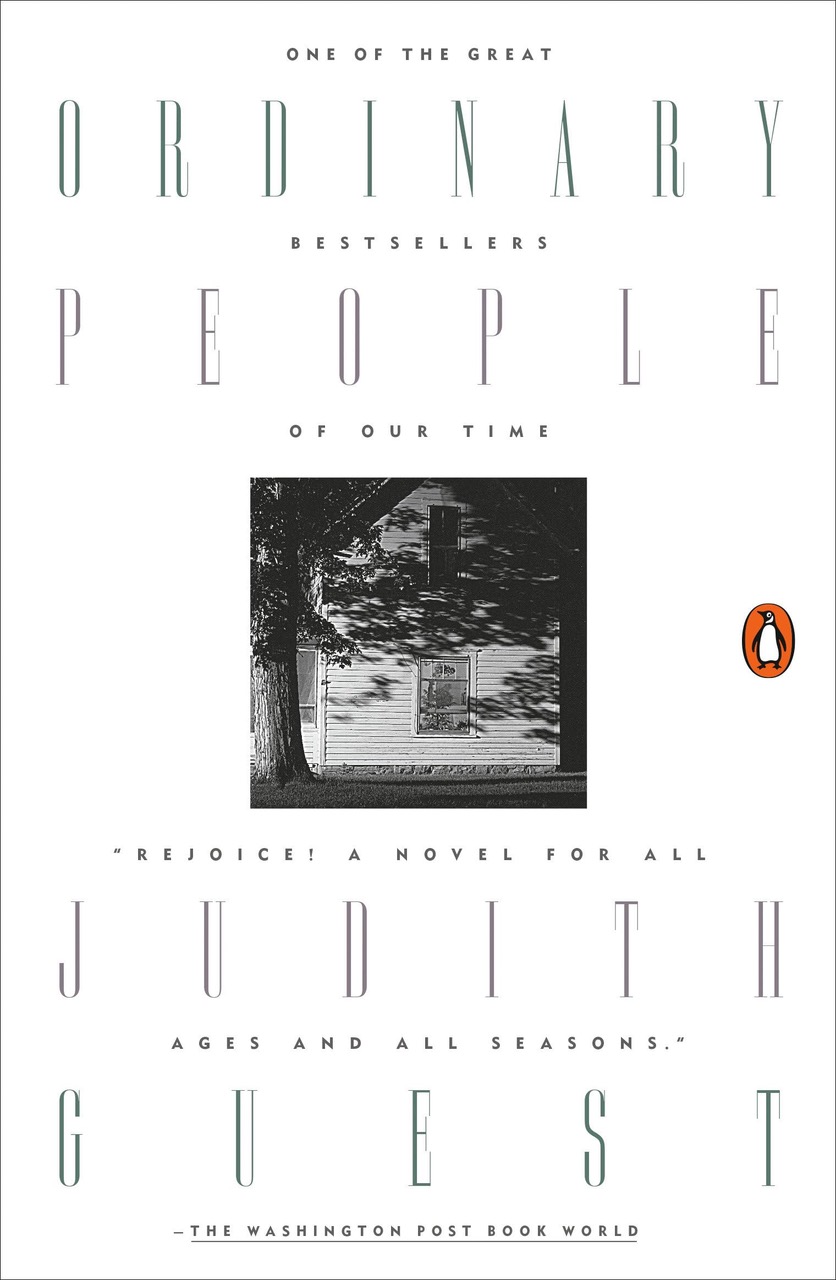
If you’ve seen the movie or read this literary bestseller, originally published by Viking Penguin in the year of America’s bicentennial, you may regard this book as a story of three characters in the same family. Like its title, Ordinary People plays upon what’s plain: a vast, dark great lake, the uniquely collegiate, Christian city of Evanston, a convertible, a choir, a psychiatrist, a Christmas tree. Its insight mines ordinary lives: a friend of the same sex—a girl from another state—a doctor with a strategy for healing—a faculty member teaching by orthodoxy—a patient who purports to care for herself as she disowns herself. This short novel dares you to gauge whether you are, know or accept ordinary people. The underestimated novel’s titular play on words lulls you with the slow, insidious sleep of suburban life before it stirs you from the slumber of what might be or become a secondhand life.
Beginning with a sonnet to embed the plot’s theme, Judith Guest begins by depicting the tension of family in crisis. The caliber of older teenager Conrad Jarrett’s innermost thoughts—what today would be termed his self-talk—excels as exposition. It’s a literary device that’s deliberately, sparingly used. “You don’t lose what you never had,” Conrad tells himself, before he’s left shivering by the third chapter after swim practice at the vaunted Lake Forest High School. After an unpleasant encounter with an athletic coach, Conrad coaches himself in an unbroken purge: “Never hit it off with the guy not even before he is too brusque, too all-knowing there is only one way to do everything, only one main street.”
Note the italics and the last two words as a play on words similar to the title’s wordplay—both stressing two generic, overused words. This casts the protagonist as an outlier who doubts the way things are done. Conrad, apparently having already learned in youth that there can be more than a single main street, questions the sense of a place and he doubts where it leads. This creates mystery and establishes Conrad as credible—even stable or on his way. Main Street, like the title of the novel by Sinclair Lewis, evokes the American essence.
This is good writing. Guest’s brief beginning shows her sense of place—Chicagoland’s North Shore—without revealing too much too soon. While dramatizing Conrad with incision, clarity and enticement, she leaves the reader wanting to learn, to know, to tread with caution. Conrad’s thought previews his burgeoning strength and resilience. The scope soon widens to include his parents, Calvin and Beth, who’re similarly revealed in subtle shifts. Theirs is a marriage which has been “arranged”; downtown Evanston tax lawyer Calvin “was never sure how it was arranged” though his golf and tennis playing wife Beth “would decide to marry him after a double date with another couple.”
The troubled child of their arranged marriage—Conrad’s recently been released from a mental ward in a medical hospital after attempting suicide, it’s disclosed—strives to create and maintain his identity, which aligns with his father’s lack of self-esteem. Add to this that his dad’s an orphan (undisclosed in Alvin Sargent’s film adaptation), his mother’s distant and her parents are overbearing and there’s a brother named Jordan, who went by Buck and died in stormy seas, and the landscape of a world going mad. All of this and north suburban Chicago’s social climbing nags at your sense of justice as it tests your values.
As it does, Ordinary People forecasts today’s ubiquitous social scorekeeping. In a culture permeated by the influence of influencers and 50 years of most things being made in—or, like the emergence of social scoring, smuggled in from—Communist China and the rule of social media algorithms with fake movements, trends and cancel culture, it’s easier to spot an emasculated husband and father and troubled boy in an obsessive-compulsive, attention-deficient enclave in 1976. Judith Guest writes about tech fatigue and the peer pressure against being “negative” pushing everyone to be numbingly “positive.”
It’s in the first sentence of chapter seven: “Karen smiles at him.” North Shore subculture pushes Conrad to smile and suppress emotion as it redirects Calvin and Beth to raise and showcase children as proof they’ve succumbed to an unspoken social contract. Beth being fixated on having everything just so—which once may have seemed quaint if obviously toxic—predicts today’s pervasive anxiety:
“…[Beth was] tense with fury as she scrubbed the fingermarks from the walls…bursting suddenly into tears because of a toy left out of place, or a spoonful of food thrown onto the floor from the high chair.”
That it is “chance and not perfection that rules the world” hints at deeper plot twists to come (and they come). Coping with uncertainty forms the basic conflict as Calvin witnesses his wife and his son spinning into separate orbits and realizes he must either choose to think or evade thinking; to go by reason or to take facts on faith. Calvin’s character arc sets up the theme that vulnerability breeds resilience. It permits the sole use of the term ordinary people (on the last page of chapter 11).
Conrad’s almost prayerful affirmation of reason—his reality check—precedes Guest’s description of grief as he shows signs of coming out of the death spiral:
“He hangs on now, pressing his hand lightly against the wall, below the window, waiting for the familiar arrow of pain. Only there is none. An oddly pleasant swell of memory, a wave of warmth flooding over him, sliding back, slowly. It is a first…He looks around: the street behind him, the shoppers, the dull-gray parking meters near the edge of the sidewalk. Everything in place; as it was before. Obscured at once by his awareness of it, the moment blurs. He cannot reach beyond it. He does not need to. At peace with himself, he walks home through the falling snow.”
The boy’s awakening comes in Evanston at Christmastime, with Judith Guest skillfully, not manipulatively, writing humor as the byproduct of love between parent and child. In conversation with his dad, Conrad explains his bold decision for a real, huge pine tree: “I tried to let you pick it out,” he tells his father Calvin. “We would have ended up with the worst one on the lot. You always want to buy some tree you feel sorry for.”
In a scene Mary Tyler Moore as Beth Jarrett softens in the film, a Christmas tree conflict cues an uprising over the morality of altruism. The boy begins to mind the gap between exercising free will and exercising his voice as his dad bridges the gulf between owning his identity and expressing his love. The aftermath yields Ordinary People’s most poignant consecutive sentences. Calvin goes to his hurting son’s side and speaks as a salve: “First,” he tells Conrad as a complete sentence. “I give a damn about everything you do.”
With music as a valve—loosened by another hero named Berger who tends to Conrad’s health—the only surviving child of Beth and Calvin Jarrett comes to terms with an “aching void of loneliness” and feeling unlovable under “a curtain of gray winter rain” before the rational doctor’s eyes “have pinned him to the wall…[under the gaze of a] hard blue light.”
Judith Guest predicts good grief psychology, even today’s progress in neurobiology, especially for pre-cognitive behavioral therapy 1976, as Dr. Berger’s lessons subvert and Beth defaults to denial through the dogged pursuit of self-esteem through the lives of others. The writer conveys (and the reader can sense) the veil of suicide. Realizing you’re reading about a possible end and a possible beginning of young life comes as a gradual, spine-chilling creep and shock.
Yet you don’t feel tricked or played. As Guest pivots to “a house on Green Bay Road”, she intensifies the dual dad/son introspection—flirting with first person in defiance of the vilified word I—in writing that pays off with a series of internal thoughts that become a wordcloud which is coherent yet strained. You begin to grasp the promise in Conrad’s egoism—as you feel the weight of his dilemma.
“I don’t want to do this alone,” Conrad admits at a crucial point. Then, the author prods protagonist and reader alike with a reference to Ernest Hemingway. An epilogue delivers punishment and reward for hanging on. This is coupled with a crushing depiction of the mother who abandons her son for not letting go—with the unspoken question of what…? as that which drives the suspense.
Whether Conrad gets the love he deserves (and deserves the love he gets) rests in three men—father, doctor, friend—and his mother Beth. This quartet shuffles the revolving picture puzzle of an American child in the fractured family. It’s 263 pages of literature which is more stirring, powerful and thoughtful than its reputation. Calvin, Berger and Lazenby are quiet heroes. Yet it’s Conrad, who becomes lighter as he grows more courageous, who gives Ordinary People its voice of reason. Judith Guest’s artistry lies in how she depicts the young, privileged, white one in peril while dramatizing that, as a mother suffocates, a father softens, strengthens and loves. This 50 year-old novel pre-dates and rejects the culture of Girl Dad, Man Cave and oversimplified terms, trends and jargon. It mines marriage, family and sexes with meaning, rejecting sarcasm, bite and snark.
What can you gain from reading Ordinary People? That a girlfriend, Jeannine Pratt, can be strong and embody the curious and vulnerable, too, as a model for nourishing life. That a boy, Jeannine’s younger brother Mike, can reflect innocence with a cowboy hat—the symbol of individualism—representing passing from boyhood to manhood. That Grandmother can be the tormentor’s tormentor—and perhaps the most pernicious character—and that a doting husband, an unserious, emasculated male, can forewarn what a man might be reduced to become. That a worldly woman can play at sports, if only as a performative means to gain prestige.
That the good is possible here on earth—that the atheist can be happy, tuneful and soulful and that the person of ability can be both damaged and self-rescuing, even if left to fend for himself as a child. That man must be free to choose to love men with tenderness, warmth and vulnerability. That, to be tender, vulnerable and selfish is rare and deserving of love and protection. That being the victim, such as losing a child, can vary and ripple in victimization. That the orphan can be heroic. That the parasite hides in plain sight, lying in wait. That obsessive-compulsive disorder is deadly and brutalizing and that the obsessor suffers first and worst. That the doctor of ability profits from the patient who’s free to choose. That the friend, like the father, mustn’t give up on the troubled boy—and that this ultimately rests with the boy in trouble practicing perseverance in small, mindful steps of his own.
That taking life seriously—with seriousness as Ordinary People’s theme—affords the lighter and enlightened life. That this is ordinary and that recognizing this is how you can and ought to enjoy being alive.